Focused on providing independent journalism.

Monday, 8 December 2014

Another banker found dead under questionable circumstances


Geert Tack Haaltert


52-year-old Belgian Geert Tack - a private banker for ING who managed portfolios for wealthy individuals - was described as 'impeccable', 'sporty', 'cared-for', and 'successful' and so as Vermist reports, after disappearing a month ago, the appearance of his body off the coast of Ostend is surrpunded by riddles...

Tack disappeared on November 5th...


Impeccable. Sporty. Cared for. Successful. Just some qualifications that are attributed to the 52-year-old from the Belgian Geert Tack Haaltert.


Geert Tack worked as a private banker for ING and managed portfolios of wealthy clients. The Belgian was much respected in the financial world and was known as an up and top professional. His sudden disappearance had the effect of a bombshell. "If Tack himself was having trouble he has managed to keep it well hidden", colleagues say.


Nobody then could have guessed that the man would not return on Wednesday, November 5th to his wife in their villa Vondelen.


And would be found dead this weekend off the coast of Ostend...


On December 3, the body was found on the coast of Ostend and removed from the water. The prosecutor confirmed today that it is Geert Tack, but it is still awaiting further results of the autopsy for the exact cause of death. The results of toxicological testing are not yet known.The examiner states that the body showed no outward signs of violence.


Geert Tack rental car found abandoned


As Vermist comments, he was well-liked and successful but the situation of his disappearance remain odd to say the least...

What makes the case very mysterious are the rather peculiar circumstances under which he disappeared. A few weeks earlier Tack drove his car to the garage and then took a replacement car. Oddly enough, he used it much later, shortly before he disappeared. Meanwhile, the car, a Renault Espace, has been found in Knokke, but Tack's whereabouts are still unknown to this day. Also - why did he find it sometimes so difficult to get to sleep in the weeks before his disappearance? Why did he leave his laptop and cell phone at home that Wednesday morning ?Although a desperate act can not be excluded, there are also people considering the missing part of a preconceived plan. From his position Tack had the opportunity - whether or not forced by third parties - to run off with money from his clients. It is a hypothesis that is being seriously investigated by the federal police, but which colleagues refuse to consider. "He would never do something like that" said one of them with certainty. "Geert is a blameless man.


This is the 36th Dead Banker of the year :

1) David Bird, 55, long-time reporter for the Wall Street Journal working at the Dow Jones news room

2) Tim Dickenson, a U.K.-based communications director at Swiss Re AG

3) William Broeksmit, 58, former senior manager for Deutsche Bank

4) Ryan Henry Crane, age 37, JP Morgan

5) Li Junjie, 33, Hong Kong JP Morgan

6) Gabriel Magee, 39, age JP Morgan employee

7) Mike Dueker, 50, who had worked for Russell Investments

8) Richard Talley, 57, was the founder and CEO of American Title (real estate titles)

9) James Stuart Jr. 70, Former National Bank of Commerce CEO was found dead in Scottsdale, Ariz

10) Jason Alan Salais, 34 year old IT Specialist at JPMorgan since 2008

11) Autumn Radtke, 28, CEO of First Meta, a Singapore-based virtual currency trading platform

12) Eddie Reilly, 47, investment banker, Vertical Group, New York

13) Kenneth Ballando, 28, investment banker, Levy Capital, New york

14) Joseph A. Giampapa, 55, corporate bankruptcy lawyer, JP Morgan Chase

15) Jan Peter Schmittmann, 57, voormalig topbestuurder ANB/AMRO, Laren, Nederland

16) Juergen Frick, 48, CEO Bank Frick & Co AG, Liechtenstein

17) Benoît Philippens, 37, directeur BNP Parisbas Fortis Bank, Ans, België.

18) Lydia..., 52, bankier Bred-Banque-Populaire, Parijs

19) Andrew Jarzyk, 27, bankier, PNC Bank, New York

20) Carlos Six, 61, Hoofd Belastingdienst en lid CREDAF, België

21) Jan Winkelhuijzen, 75, Commissaris en Fiscalist (voormalig Deloitte), Nederland.

22) Richard Rockefeller, 66, achterkleinzoon elitebankier John D. Rockefeller, Amerika

23) Mahafarid Amir Khosravi (Amir Mansour Aria), 45, bankeigenaar, zakenman en derivatenhandelaar, Iran

24) Lewis Katz, 76, zakenman, advocaat en insider in de bancaire wereld, Amerika

25) Julian Knott, Directeur Global Operations Center JP Morgan, 45, Amerika

26) Richard Gravino, IT Specialist JP Morgan, 49, Amerika

27) Thomas James Schenkman, Managing Director Global Infrastructure JP Morgan, 42, Amerika

28) Nicholas Valtz, 39, Managing Director Goldman Sachs, New York, Amerika

29) Therese Brouwer, 50, Managing Director ING, Nederland

30) Tod Robert Edward, 51, Vice President M & T Bank, Amerika

31) Thierry Leyne, 48, investeringsbankier en eigenaar Anatevka S.A., Israël

32) Calogero Gambino, 41, Managing Director Deutsche Bank, Amerika

33) Shawn D. Miller, 42, Managing Director Citigroup, New York, Amerika

34) Melissa Millian, 54, Senior Vice President Mass Mutual, Amerika

35) Thieu Leenen, 64, Relatiemanager ABN/AMRO, Eindhoven, Nederland

36) Geert Tack, 52, Private Banker ING, Haaltert, België


The Cop Who Killed Eric Garner Was Previously Sued For Civil Rights Violations


The cop who killed a man while trying to subdue him for arrest (pictured above) has been sued several times for allegedly violating the constitutional rights of black men, USA Today reports.


Daniel Pantaleo, a 29-year-old officer for the New York Police Department, put 43-year-old Eric Garner, a black man, in a chokehold on Staten Island when Garner tried to resist arrest. Garner, who was unarmed, told police he wasn’t doing anything wrong and wouldn’t let them touch him.


The NYPD faced accusations of racism and racial profiling after the release of a bystander tape that showed several cops crowding around a nonviolent Garner and Pantaleo hooking his arm around Garner’s neck and dragging him to the ground.


Yet another reason to detest police brutality: Taxpayers bear the burden of damages rewarded


A UCLA Law Professor has found that in cases of police brutality, damages rewarded in suits against the city of New York are almost entirely paid for by taxpayers, with just a fraction of the cost incurred by officers involved or the NYPD as a whole.

Joanna Schwartz, who has extensive experience studying and analyzing cases of misconduct amongst police nationwide, presented her findings in a paper she wrote recently for the New York University Law Review. In the paper, Schwartz determines that taxpayers "almost always satisfy both compensatory and punitive damages awards entered against their sworn servants."


In the case of Eric Garner, the Staten Island man who was killed after NYPD officer Daniel Pantaleo put him in a chokehold in an attempt to arrest him, the grand jury decision not to indict Pantaleo for Garner's death has prompted the victim's family to sue the city of New York for $75 million. Schwartz believes that Pantaleo may have to pay a very small portion of the damages, but it will ultimately be NYC taxpayers who foot the bill.


"I do imagine the officers will be indemnified," Schwartz said. "If you look at big cases involving the NYPD that settled between 2006 and 2011, including suits relating to the shooting of Sean Bell, there was no contribution by involved officers. New York has required officers to contribute small amounts when officers have been found to be acting outside of policy.


I suppose this could happen in this case, but feel fairly certain given my research about indemnification that the involved officers would, at most, be required to contribute a minuscule fraction of any amount collected by the family."


According to CityLab.com, research conducted by Schwartz from civil rights cases settled between 2006 and 2011 shows that of the 9,225 cases and $735 million total in damages awarded in large cities, "officers personally paid less than $171,300 of that total - or just .02 percent." Data from cases in small and mid-sized cities shows that of the $9.4 million in total damages rewarded during the time period, none of it was actually paid for by the NYPD or its officers.


A single instance in which a New York officer paid the full amount in a settlement involved a then-off-duty officer whose dog attacked someone. That officer paid $16,500.


Schwartz concludes her study by arguing that the system leans in favor of the plaintiff in cases of police misconduct.


"For several decades, the Supreme Court has crafted civil rights doctrines - including qualified immunity and limitations on municipal liability and punitive damages - based on unfounded assumptions, and many times has done so in ways that make it more difficult for plaintiffs to prevail. This Article rebuts one of those assumptions: that law enforcement officers are personally responsible for settlements and judgments entered against them."


SOTT Exclusive: U.S. Congress anti-Russia law pulls the Empire of Chaos deeper into the black hole of its own making


black hole M60-UCD1

© shabalgnob.blogspot.com

Gigantic black hole spotted by Hubble


The U.S. Empire's plan was to use the chaos it generated in Ukraine to draw Russia into an overt military intervention, and to ultimately isolate, divide and pacify Russia. This is according to political analyst Andrew Korbyko, who labels this bizarre strategy the 'Reverse Brzezinski':

The idea is to create 'black holes' of absolute disorder in which Moscow, Beijing, and Tehran are "damned if they do, damned if they don't" intervene. [...]


When it comes to Ukraine, humanitarian atrocities and war crimes are purposely being undertaken in order to anger the Russian leadership and provoke an emotional military reaction. [...]


The US sought to capitalize off of the chaos present in Syria and Ukraine in order to create 'black holes' to suck in Iran and Russia.


Whatever outcomes the Washington elites they would get, it's becoming increasingly obvious that this strategy has failed miserably. Putin recently stated that Russia won't fall for such tactics:

"We are not threatening anyone and are not planning to get involved in any geopolitical games, intrigues and especially conflicts, no matter who would want to pull us into them," Putin said at a meeting with military chiefs in the Black Sea resort of Sochi on Wednesday.


It seems that these 'black holes' are now sucking in their own creators and bringing about their downfall, producing the opposite result to what the 'Empire of Chaos' wanted. The same outcome can be expected from any future attempts by the West to undermine Russia. This is made clear with the recent decision by Russia to scrap the South Stream pipeline and open up of a new Blue Stream pipeline.

As one Russian commentator put it, "Putin is now forcing the EU to recognize the mess in Ukraine is not Russian, but a European problem." We can also see clearly that Putin is not the one trying to 'revive the Russian Empire' - quite the opposite, it's the U.S. and their allies vassals that are behaving more overtly as an empire. The psychopaths running the Western Empire always need an enemy to justify their plans, but they prefer to use enemies they control for that purpose (ISIS, for example). Their portrait of Putin-as-Hitler is indicative of the threat this enemy poses. Lada Rey writes in 'Is Putin part of New World Order?':


Since US cannot be seen as a positive force any more, the only thing that is left for its propaganda is to discredit the opponent. To do that, the US needs to twist the reality in such a way that the opponent is painted with the tainted brush.


So what's next for the Empire of Chaos? Enter House Resolution 758. Here's Pepe Escobar's take on the resolution.

I can't emphasize enough how terrifying - and stupid - this is.


And now it's official.


House Resolution 758 was approved yesterday by an overwhelming, bipartisan 411-10 score at the US Congress.


See the vote breakdown here:

http://ift.tt/1AqSu2e


This resolution, rushed to a vote only two weeks after it was introduced, depicts Russia as an "Aggressor Nation" which has invaded Ukraine and was behind the downing of MH-17.


The resolution virtually calls for war on Russia.


Take a very good look at the language:


The President of the United States, in consultation with the US Congress, must...


"conduct a review of the force posture, readiness, and responsibilities of the United States Armed Forces and the forces of other members of NATO to determine if the contributions and actions of each is sufficient to meet the obligations of collective self defense under article 5 of the North Atlantic Treaty and to specify the measures needed to remedy any deficiencies" .


Translation: the US Congress wants the Empire of Chaos to use NATO's collective security doctrine under article 5 (an attack on one member is an attack on all members) to advance a war on Russia, even though Ukraine is not a member (but will soon become a major non-NATO ally).


The resolution now goes to the Senate.


If it becomes law, the resolution allows the President of the United States to declare war on Russia bypassing the formal permission of Capitol Hill.


The lame duck wouldn't have the balls. But the Hillarator will.


Ron Paul rightly states the bill is nothing but "16 pages of war propaganda that should have made even neocons blush." He further states that the U.S. is provoking a war against Russia that "could result in total destruction" of both countries.

With the failure of their covert strategies, are the Western elite now opting for more overt undertakings? Perhaps so, but we should keep recent statements by Dmitry Orlov in mind.


Dmitry Orlov: Well, to keep their positions, they have to continue posturing and part of that posturing is pretending that you're acting from a position of strength whereas you're actually acting from a position of weakness. That's already happening in the US and the posturing isn't working out very well either. So, in China recently, Obama made a speech about American leadership in the world and all of these young Chinese people in the audience started laughing. Now, if you send your leader somewhere across the world, and young people laugh at him, that's not a good sign, right?


[...]


I don't think there'll be any outright all out confrontation because total war between the United States and Russia is unwinnable by definition. I think that basically, there will be efforts by the US to continue what it tries to do with less and less success, various types of Orange Revolutions. And they're working out worse and worse every time. I mean look at the results. It used to be that they actually kind of got the government they wanted for a little while. But now, they don't even get that for any length of time and the countries that they try to set up, like Libya for instance, fall apart really quickly. If you look at Georgia, where they put in Mikheil Saakashvili as the President, well, now he's basically a wanted men in his own country. He's been hiding out somewhere in the states. It's just not working out very well but they'll continue doing it until it just all falls apart.


Russia is forced by the circumstances (full-spectrum anti-Russian information war, economic sanctions, 'balkanization' on its doorstep) to respond in creative ways that protect its own interests, draws allies to its principled stance, and minimizes the loss of life and property for everyone involved... while the U.S. Empire is getting swallowed into a black hole of its own making.


Avatar

Ante Sarlija (Profile)


Born and raised in Croatia, Ante joined the SOTT editorial team in 2014. He is also a part of the Croatian SOTT translation team. His area of interest includes, among other things, Philosophy and Politics. In his spare time he enjoys reading, researching, listening to music and smoking.


CIA bracing for 'most damaging moment' - Release of report detailing its 'embrace of torture'


© Manuel Balce Ceneta/AP

Secretary of state John Kerry asked Dianne Feinstein on Friday to consider the timing of the expected release of a report on CIA interrogation techniques.


The CIA is bracing for what could be one of the most damaging moments in its history: a public airing of its post-9/11 embrace of torture.

The Senate intelligence committee is poised to release a landmark inquiry into torture as early as Tuesday, even as the Obama administration has made a last-ditch effort to suppress a report that has plunged relations between the CIA and its Senate overseer to a historic low point.


The release of the torture report will represent the third major airing of faulty CIA intelligence in 15 years, following official commissions into the 9/11 plot and Saddam Hussein's defunct illicit weapons programs.


Despite months of negotiation over how much of the 6,000-page report will be declassified, most of its findings will never see the light of the day. But even a partial release of the report will yield a furious response from the CIA and its allies.


On Sunday, George W Bush made a show of support for CIA operatives who had participated in torture, calling them "patriots".


"We're fortunate to have men and women who work hard at the CIA serving on our behalf," he told CNN. "These are patriots and whatever the report says, if it diminishes their contributions to our country, it is way off base."


The Senate report is likely to attract global attention, owing to the CIA's network of unacknowledged prisons in places like Poland, Thailand and Afghanistan.

Human-rights investigators have found 54 countries cooperated in various ways with the CIA's renditions, detentions and interrogations, but the commitee is unlikely to reveal the agency's foreign torture partners.


On Friday, secretary of state John Kerry called Senator Dianne Feinstein - the California Democrat who spearheaded the inquiry - to urge consideration of what spokeswoman Jen Psaki called the "foreign policy implications" of the report's timing, suggesting it could inflame anti-American outrage worldwide.


Bloomberg first reported that the committee understood Kerry to be arguing for suppressing the report, though the State Department denies it.


Congressman Mike Rogers, the Republican chair of the House Intelligence Committee said on Sunday that US allies have warned that the release of the report could provoke "violence and deaths".


"I think this is a terrible idea," Rogers told CNN. "Foreign leaders have approached the government and said, 'You do this, this will cause violence and deaths.' Our own intelligence community has assessed that this will cause violence and deaths."


Several foreign governments, including the UK and Poland, are fearful of identification by the Senate and have added to the pressure on the committee.

Some of the CIA's major allies included dictators whom Barack Obama relinquished US support for or even went to war to depose, such as Egypt's Hosni Mubarak, Libya's Muammar Gaddafi, and Syria's Bashar al-Assad.


Jose Rodriguez, a former senior CIA official who has ardently defended torture, has already published an op-ed accusing Feinstein and her committee allies ofbreaking faith with a CIA it once wanted to do its utmost to stop terrorism. Several former CIA directors and Bush officials intend to argue that the Senate investigation is itself misleading.


Rodriguez, writing in the Washington Post, said that the committee's conclusion that torture "brought no intelligence value is an egregious falsehood" and termed the report "a dishonest attempt to rewrite history".


The report's fundamental conclusions have been well-trailed. Senate investigators determined that the CIA's embrace of mock-drowning, sleep deprivation, "stress positions", sensory and dietary manipulation and other torture techniques were ineffective, and the CIA covered up that ineffectiveness by misrepresenting its results to Bush officials, Congress and the public.


Its executive summary examines 20 such instances during the 2002-2006 height of what the CIA prefers to call "enhanced interrogation techniques".


After the committee voted in April to declassify sections of the report, Feinstein called the CIA's actions a "stain on our history".


Feinstein hoped the committee would finish its declassification negotiations with the administration within 30 days. Yet the White House placed the CIA in charge of censoring a report into its own conduct and discussions have stretched into their 10th month. In August, Feinstein and other leading Senate Democratsrejected proposed administration redactions, saying they would leave the committee's findings incomprehensible. The agency has rejected even the use of pseudonyms for its operatives on the grounds they could reveal classified identities.

In an interview with the Los Angeles Times, Feinstein conceded that she had been obliged to give in on some of her demands for transparency: "We have to get this report out."


"We will find another way to make known some of the problems," she said.


The drawn-out process has prompted speculation that the administration wants to outlast Feinstein's tenure as chairwoman and prefers for committee Republicans, who consider the inquiry a wasteful witch hunt, to preside over its partial release come January. Two committee Democrats, Ron Wyden of Oregonand Mark Udall of Colorado, have publicly flirted with using parliamentary procedure to force disclosure, considered to be an attempt at exerting pressure on the administration.


Human rights campaigners have pressured the White House for months to release a maximally declassified report so as to hold the CIA accountable. It is unlikely to lead to any legal consequence for CIA officials, particularly after a special Justice Department inquiry into torture declined to indict anyone for abuses in the CIA program. The report's greatest legal impact may be on the military tribunal for the accused 9/11 co-conspirators, whose lawyers wish to introduce the report into evidence that their clients were tortured into delivering inadmissible statements implicating themselves.


Hostility to the report is not restricted to the right wing. Human rights groups have criticized Senate investigators for not looking into the Bush administration architects of the program in a concession to committee Republicans, and for declining to attempt a definitive legal analysis of torture. While the CIA has criticized the inquiry for not interviewing its operatives, lawyers for CIA torture victims have said Senate investigators did not seek to interview their clients, either.


Beyond questions of accountability, a lingering effect of the report is likely to be damage between the CIA and the secret Senate committee that oversees the powerful intelligence agency.


Director John Brennan had to apologize in July after the CIA inspector general determined that agency officials surreptitiously accessed committee work product and email on a firewalled shared network. Brennan had initially denied wrongdoing that Feinstein stated had provoked a constitutional crisis. Udall and others have called on Brennan - himself a senior CIA official during the time of the inquiry's focus - to resign.


All eyes on Hawaii: Ban GMO's; don't settle for labeling

Hawaii

© unknown


Let me put it this way. It would mean a lot more than winning a few GMO-labeling initiatives.

"The right to choose what's in your food" does not stop the ongoing gene drift, from GMO crops to non-GMO, across America. This drift is well on its way to making organic crops into genetically modified food, whether we like it or not.


And the blown-on-wind spread of tons and tons of Roundup, the poisonous Monsanto herbicide so "vital" to GMO farming...well, that's straight-out chemical warfare.


As it continues, what organic farmer will be able to guarantee his crops are pristine?


In Hawaii, we have a far different situation. Voters on the Big Island, Maui, and Kauai, against all odds, have managed to pass measures that would block Monsanto (and other biotech giants) from continuing their GMO/pesticide operations.


In other words, ban, not label.


However, on the Big Island and Kauai, the corrupt court system has (so far) rendered the voters' decisions null and void. On Maui, the same tactic is in progress.


Hawaii isn't just a small biotech center. Huge numbers of GMO seeds are produced and shipped out around the world.


Monsanto, Dow, Pioneer, and BASF are doing intensive R&D to develop new GMO seeds and new poisonous pesticides (which they are spraying on the people of Hawaii).


Cutting off their work in Hawaii would be a major victory.


However, if you did an overall survey of news sites, including independent centers of reporting, you'd find GMO labeling has been garnering far more coverage than the bans enacted in several US counties or the struggle in Hawaii.


Why is that?


One reason: the anti-Monsanto movement in America has been shaped and funded to be about product-labeling.


Because it's about shopping and choosing and buying and consuming, it seems to have more "broad appeal."


But how well is that soft approach going to work in the face of the biotech fait accompli - gene drift plus pesticide drift, blanketing the whole country, penetrating all food crops?


According to "received wisdom," banning GMOs and their attendant pesticides is a much harder sell.


In past articles, I've outlined an attack strategy against the biotech giants that could have worked at the outset of the anti-GMO movement - and could still work. I won't run it all down here. Suffice to say, it is predicated on the understanding that we are in a late-game situation, and the clock is ticking.


The biotech crime bosses are running the show - our show - into the ground. The sane response is to go all-out on the offensive. This is miles beyond avoiding a potato in the market labeled "GMO."


And by the way, who would be in charge of putting those GMO labels on foods? The state governments where the labeling initiatives pass? Really? You would trust that process to be both honest and competent?


The leaders of the labeling movement apparently welcome the prospect of Monsanto and their allies suing states in which labeling initiatives or laws pass. This is a chance to expose the shady tactics of the biotech giants.


I would point out, though, that such court battles would ultimately impact only the labeling issue, nothing more.


Yes, it would represent another small step in educating the public about these monster corporations - but small steps that come too late are not useful.


In Hawaii, however, there is an authentic spark. The fight centers around the possibility of a partial ban on GMOs and dangerous pesticides - in the heart of the enemy's camp.


The outcome would be helped considerably, if enough people shifted their focus to the Islands, where the real action is. Now.


In Hawaii, the reality-egg has cracked. The Monsanto facade of GMO/pesticide safety and humane intentions has been blatantly rejected, on the record, by voters.


This has set off a parade of biotech/political/judicial/land-baron counter-attacks. The players are, as usual, arrogant, self-entitled, devious, slimy, fake Jesuses who want to save the world and lift up the less fortunate and less informed.


"We'll help you. Just let us run things."


Hawaii could be a candle that is quickly snuffed out, or it could become a sun that illuminates the truth.


The point is, the struggle there is about the right thing. Stopping the poisoners. Not labeling them.


Experts say that record heat causes record ice

Growing Ice

© International Business Times


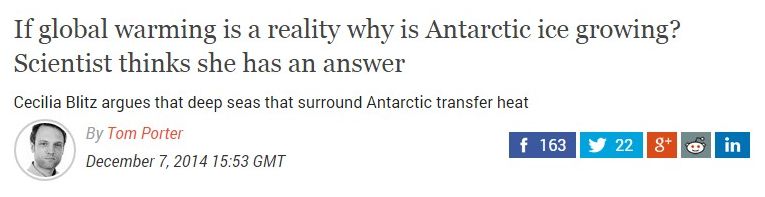
It is one of the greatest puzzles in the science of climate change, and has been used by skeptics to cast doubt on global warming: Why, when the world is getting hotter, is the Antarctic getting colder?

Now, a scientist thinks she may have uncovered the answer.


Cecilia Bitz, an atmospheric scientist from the University of Washington in Seattle, believes that oceanic currents are taking heat away from Antarctica and carrying it north, reports the Sunday Times.


Yesterday, experts said that hot ocean currents around Antarctica are melting the glaciers, and today they say that ocean currents are making the water cold around Antarctica.


Another study has been published, concluding that warmer ocean waters are melting Antarctic glaciers and contributing to sea level rise. The West Antarctic Ice Sheet has enough land ice to raise sea level by 16 feet alone. Meanwhile, 2014 is making the record books as the hottest year in recorded meteorological history.


Scientists predict 16 FEET of SEA LEVEL RISE as a literal Mt. Everest melts into Antarctic seas every two years - Green - News - Catholic Online


In summary, global warming makes the water around Antarctica both hot and cold, and causes both record ice and record melt.