Focused on providing independent journalism.

Saturday, 30 May 2015

New study finds major faults offshore in southern California could trigger large earthquakes, tsunamis

© Mark Legg
This map shows the California Borderland and its major tectonic features, as well as the locations of earthquakes greater than Magnitude 5.5. The dashed box shows the area of the new study. Large arrows show relative plate motion for the Pacific-North America fault boundary. The abbreviations stand for the following: BP = Banning Pass, CH = Chino Hills, CP = Cajon Pass, LA = Los Angeles, PS = Palm Springs, V = Ventura; ESC = Santa Cruz Basin; ESCBZ = East Santa Cruz Basin Fault Zone; SCI = Santa Catalina Island; SCL = San Clemente Island; SMB = Santa Monica Basin; SNI = San Nicolas Island.

    
While their attention may be inland on the San Andreas Fault, residents of coastal Southern California could be surprised by very large earthquakes -- and even tsunamis -- from several major faults that lie offshore, a new study finds.

The latest research into the little known, fault-riddled, undersea landscape off of Southern California and northern Baja California has revealed more worrisome details about a tectonic train wreck in the Earth's crust with the potential for magnitude 7.9 to 8.0 earthquakes. The new study supports the likelihood that these vertical fault zones have displaced the seafloor in the past, which means they could send out tsunami-generating pulses towards the nearby coastal mega-city of Los Angeles and neighboring San Diego.

"We're dealing with continental collision," said geologist Mark Legg of Legg Geophysical in Huntington Beach, California, regarding the cause of the offshore danger. "That's fundamental. That's why we have this mess of a complicated logjam."

Legg is the lead author of the new analysis accepted for publication in the , a journal of the American Geophysical Union. He is also one of a handful of geologists who have been trying for decades to piece together the complicated picture of what lies beyond Southern California's famous beaches.

The logjam Legg referred to is composed of blocks of the Earth's crust caught in the ongoing tectonic battle between the North American tectonic plate and the Pacific plate. The blocks are wedged together all the way from the San Andreas Fault on the east, to the edge of the continental shelf on the west, from 150 to 200 kilometers (90 to 125 miles) offshore. These chunks of crust get squeezed and rotated as the Pacific plate slides northwest, away from California, relative to the North American plate. The mostly underwater part of this region is called the California Continental Borderland, and includes the Channel Islands.

By combining older seafloor data and digital seismic data from earthquakes along with 4,500 kilometers (2,796 miles) of new seafloor depth measurements, or bathymetry, collected in 2010, Legg and his colleagues were able to take a closer look at the structure of two of the larger seafloor faults in the Borderland: the Santa Cruz-Catalina Ridge Fault and the Ferrelo Fault. What they were searching for are signs, like those seen along the San Andreas, that indicate how much the faults have slipped over time and whether some of that slippage caused some of the seafloor to thrust upwards.

What they found along the Santa Cruz-Catalina Ridge Fault are ridges, valleys and other clear signs that the fragmented, blocky crust has been lifted upward, while also slipping sideways like the plates along the San Andreas Fault do. Further out to sea, the Ferrelo Fault zone showed thrust faulting -- which is an upwards movement of one side of the fault. The vertical movement means that blocks of crust are being compressed as well as sliding horizontally relative to each other-what Legg describes as "transpression."

Compression comes from the blocks of the Borderland being dragged northwest, but then slamming into the roots of the Transverse Ranges -- which are east-west running mountains north and west of Los Angeles. In fact, the logjam has helped build the Transverse Ranges, Legg explained.

"The Transverse Ranges rose quickly, like a mini Himalaya," Legg said.

The real Himalaya arose from a tectonic-plate collision in which the crumpled crust on both sides piled up into fast-growing, steep mountains rather than getting pushed down into Earth's mantle as happens at some plate boundaries.

As Southern California's pile-up continues, the plate movements that build up seismic stress on the San Andreas are also putting stress on the long Santa Cruz-Catalina Ridge and Ferrelo Faults. And there is no reason to believe that those faults and others in the Borderlands can't rupture in the same manner as the San Andreas, said Legg.

"Such large faults could even have the potential of a magnitude 8 quake," said geologist Christopher Sorlien of the University of California at Santa Barbara, who is not a co-author on the new paper.

"This continental shelf off California is not like other continental shelves -- like in the Eastern U.S.," said Sorlien.

Whereas most continental shelves are about twice as wide and inactive, like that off the U.S. Atlantic coast, the California continental shelf is very narrow and is dominated by active faults and tectonics. In fact, it's unlike most continental shelves in the world, he said. It's also one of the least well mapped and understood. "It's essentially terra incognita."

"This is one of the only parts of the continental shelf of the 48 contiguous states that didn't have complete ... high-resolution bathymetry years ago," Sorlien said.

And that's why getting a better handle on the hazards posed by the Borderland's undersea faults has been long in coming and slow to catch on, even among earth scientists, he said.

NOAA was working on complete high-resolution bathymetry of the U.S. Exclusive Economic Zone -- the waters within 200 miles of shore -- until the budget was cut, said Legg. That left out Southern California and left researchers like himself using whatever bits and pieces of smaller surveys to assemble a picture of what's going on in the Borderland, he explained.

"We've got high resolution maps of the surface of Mars," Legg said, "yet we still don't have decent bathymetry for our own backyard."

The pressure just shifted from Greece to the US and EU

Image

© JEWEL SAMAD/AFP/GETTY IMAGES

    
With the 3rd US Q1 GDP print coming in at -0.7% (-3% if not for inventories), perhaps the media spotlights - and lively imagination - can move away from Greece for a few weeks. The US has enough problems of its own, it would seem. For one thing, its Q1 GDP is now worse than Greece's. Of course its debt is also much higher, just not to the IMF and ECB. But let's leave that one be for the moment. Though a bit of perspective works miracles at times.

Of course it's not a technical recession yet for the US, which only recently presented a +4% quarter with a straight face, and there's always the 'multiple seasonal adjustment' tool. But still. It's ugly.

The IMF confirmed on Thursday that Athens has the right to ask for "bundled" repayments in June. "Countries do have the option of bundling when they have a series of payments in a given month ... making a single payment at the end of that month," as per an IMF spokesman. Who added that the last country to do so was Zambia three decades ago.

That leaves Athens, in theory, with a 30-day window, not a 7-day one. This of course takes the pressure cooker away from Athens, and the media attention as well. There is no immediate risk of a default, or a Grexit, or anything like that. The negotiations with the creditors will continue, but the conversation will change with time less of an issue.

One thing that's changing is that the pressure on the other eurozone countries is rising fast. They might yet get to regret the way 'their side' conducts the debt talks with Syriza, in which they are a party through the eurogroup of finance ministers. Because it makes ever more deposits disappear from Greek banks, some €300 million in the past few days alone. That triggers a eurozone 'program' entitled Target2. For those who don't know what it is, I'll use an explanation by Mish from 2012:

Simply put, the ECB sends money to the Bank of Greece in a kind of open credit line to make up for the cash that left the Greek bank. There are some restrictions, but not many. This is not a major problem unless Greece changes currencies, or defaults. If it does, Greece will repay the credit line with Drachmas, not euros.

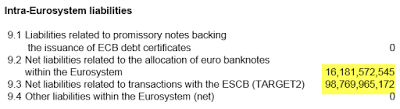
There are quite a few other ways in which the rest to the eurozone is on the hook for Greek debts, but this is a major one. Right now, so-called 'Intra-Eurosystem Liabilities' from the Greek national bank, the Bank of Greece, have risen to €115 billion and counting -fast-. Germany's on the hook for 27% of that, or €31 billion. While that is not life threatening for Germany, other countries will not feel that comfortable.
Image
    
Countries like Spain and Portugal may by now scratch their heads about taking a hard line on the Greek issue. They may not have fully realized to what extent the eurozone is indeed a shared commitment. All eurozone nations now have at least another 30 days to think that over. The main risk in that period is that Greece may decide to leave on its own.

The 30-day grace period will probably dampen the deposit outflows for a bit, depending on what both parties have to offer in the way of statements going forward. And the incumbent 'leaders' in various countries can use the time to try and tell the troika that they don't want to explain the potential losses to their voters. There are elections coming up all over, starting with Italy this weekend.

There is another possibility: that the ECB makes good on its long running threat of limiting Greek banks' access to the ELA program. But, given the 30-day 'grace', and given that it would be seen as a political move by at least some parties, that seems unlikely. And it's not like the entire thing has now become predictable, just that there's breathing space. In which clearer -and smarter- heads can prevail.

As for the US, it's spring, the season to adjust. But -0.7% still stings, and things ain't going well at all no matter what anybody tells you.

How FIFA Makes (And Spends) Its Money

How does the Zurich-based multi-million-pound organisation make its money and what does it spend it on?

The US-led part of the twin investigations is looking at corruption among members of the Concacaf and Conmebol, the confederations that represent national associations across the Americas and the Caribbean, but the entire structure is considerably more broad...

Any uncertainty around the World Cup is a major concern to the organisation. Fifa's own financial reports give a clear indication of how reliant the organisation is on the income each tournament generates.

The World Cup is the most lucrative sporting event in the world, eclipsing even the Olympics. The 2014 qualifying rounds and final tournament brought in $4.8bn (£3.1bn) over four years and, after costs are taken into account, Fifa made a profit of more than $2bn.

Profit from the 2014 World Cup

How much money does Fifa hold on to?

Fifa re-invests the majority of its revenue but it does hold on to a proportion of any profit to create a cash reserve. Fifa says that the reserve is important as it is extremely difficult to find insurance to cover the possible last-minute cancellation of a World Cup.

The value of this reserve has grown sharply in the last decade from $350m (£228.6m) in 2005 to more than $1.5bn (£1bn) in 2014.

The US indictment alleges over $150m (£97m) in corruption during a period of over 20 years. That currently equates to around 10% of the money Fifa has on hand for emergencies.

A further worry for FIFA is that its sponsors and "partners" (extra-privileged sponsors) seem displeased by the latest bout of scandals. Coca-Cola are concerned that such accusations have “tarnished” the World Cup. Visa has warned that it may reassess its FIFA sponsorship unless the organisation can come to grips with its internal problems.

That is money FIFA will not want to lose. Marketing is a cornerstone of FIFA’s swelling balance sheet, accounting for about a third of its $2 billion in yearly revenues.


Increased interest in football from Asia and Africa has swelled the flow of money from television-broadcasting rights. A favourable tax status in Switzerland helps too: FIFA only pays around 1% of its income to state coffers. With cash rolling in, the organisation has built up healthy reserves of $1.5 billion, ostensibly for a rainy day.

At long last the storm clouds appear to be gathering.

Source: The BBC and The Economist

*  *  *

However, the most importantchart for FIFA is the following... Spot The Odd One Out...

Restricted U.S. Army Special Operations Forces Manual

FM 3-18 Special Forces Operations

  • 160 pages
  • Distribution authorized to U.S. Government agencies and their contractors only to protect technical or operational information from automatic dissemination under the International Exchange Program or by other means.
  • May 28, 2014

Download

FM 3-18 is the principal manual for Special Forces (SF) doctrine. It describes SF roles, missions, capabilities, organization, mission command, employment, and sustainment operations across the range of military operations. This manual is a continuation of the doctrine established in the JP 3-05 series, ADP 3-05, ADRP 3-05, and FM 3-05.

The principal audience for FM 3-18 is all members of the profession of arms. Commanders and staffs of Army headquarters serving as joint task force (JTF) or multinational headquarters should also refer to applicable joint or multinational doctrine concerning the range of military operations and joint or multinational forces. Trainers and educators throughout the Army will also use this publication.

There has always been a romantic fascination with special operations forces (SOF). The idea of secret commandos or Rangers striking from the shadows surprising the enemy with overwhelming speed, violence of action, and cutting-edge technology appeals to America’s image of highly trained, elite Soldiers. There is, however, another Soldier who fights from the shadows. This one is perhaps less known and far less understood. His real weapons are a deep understanding of terrain, the relationships built, and the influence developed to motivate and train others to take up the fight. These Soldiers are the U.S. Army SF, the “quiet professionals” whom history and popular culture often overlook. Designed to organize, train, and support indigenous personnel in behind-the-lines resistance activities, SF belongs to an organization unique in the Army’s history. Founded at the Psychological Warfare Center at Fort Bragg in 1952 and based upon lessons learned and formation used in guerrilla warfare during World War II, its sole purpose was UW. The experience in Vietnam gave SF a second purpose: countering a subversive insurgency. This brief history identifies the precursors and major developments that created modern U.S. Army SF.

STRATEGIC CONTEXT

2-3. SF operations historically have been used to shape the environment, to conduct condition-setting activities, and to enable maneuver warfare or other operations. The discreet, precise, and scalable nature of SF operations often makes them a more attractive option in instances where a large force structure may be inappropriate or counterproductive or may incur political risk. When used effectively, these types of operations can yield disproportional benefits.

2-4. SF operations are one means by which the President of the United States, Secretary of Defense, Department of State country teams, and geographic combatant commanders (GCCs) can shape an environment to support the U.S. National Security Strategy. The National Security Strategy prepared by the Executive Branch for Congress, outlines the major national security concerns of the United States and how the administration plans to deal with them. It provides a broad strategic context for employing military capabilities in concert with other instruments of national power. SF contributes to the National Security Strategy in the following ways:

  • As an instrument to implement or enforce U.S. National Security Strategy outside of an overt military campaign, SF specializes in persistent engagement. SF implements the National Security Strategy developed within a strategic security environment characterized by uncertainty, complexity, rapid change, and persistent conflict. They possess capabilities that enable both lethal and nonlethal missions specifically designed to influence threat, friendly, and neutral audiences. They shape foreign political and military environments by working with HNs, regional partners, and indigenous populations and their institutions. Such proactive shaping can help prevent insurgencies and/or conflicts from destabilizing partners and ultimately deter conflict, prevail in war, or succeed in a wide range of potential contingencies.
  • In support of a military campaign, SF acts as a force multiplier through UW and extends the operational reach to influence and strike enemy forces throughout their depth. The use of SF to organize, train, and employ indigenous forces operating in the enemy rear area prevents effective employment of reserves, disrupts command and control and logistics, and forces the enemy to cope with U.S. actions throughout its entire physical, temporal, and organizational depth. Utilizing indigenous information networks provides powerful tools for leaders to synchronize efforts. Synchronized efforts between conventional and unconventional forces offer Army leaders with the capability to integrate actions along with interagency and multinational efforts to overwhelm the enemy and achieve decisive results. UW is the signature excellence of SF. Whether used as a supporting effort to major combat operations or as an alternative, UW strikes the enemy in times, places, and manners for which the enemy is not prepared, seizing the initiative by forcing the enemy to defend everywhere at once.

2-5. Two keys in achieving tactical, operational, and strategic successes are flexibility and adaptability. U.S. Army SF Soldiers work in small teams and are well known for taking initiative, acting quickly, and having an affinity for innovation in thought, plans, and operations—all important factors in a flexible organization. This type of flexibility allows small-footprint, politically sensitive responses when large-scale military employment may be inappropriate or denied. Adaptability first requires an understanding of the operational environment. Sustained engagement around the world, along with scalable features, makes SF teams the most ubiquitous ground forces with both lethal and nonlethal capabilities. Their low profile and an inherent need to network with interagency partners, indigenous populations, and indigenous systems reflect the adaptive nature of SF teams. Their widespread and persistent engagement makes SF teams agile and responsive to rapidly changing regional situations that affect our national security interests.

2-6. The 2010 National Security Strategy reaffirmed the U.S. commitment to retaining its global leadership role and defined U.S. enduring national interests as follows:

  • The security of the United States, its citizens, allies, and partners.
  • A strong, innovative, and growing U.S. economy in an open international economic system that promotes opportunity and prosperity.

Respect for universal values at home and around the world.
An international order advanced by U.S. leadership that promotes peace, security, and
opportunity through stronger cooperation to meet global challenges.

2-7. The National Security Strategy and the 2010 Quadrennial Defense Review together guide the establishment of U.S. national military objectives as follows:

  • Counter violent extremism.
  • Deter and defeat aggression.
  • Strengthen international and regional security.
  • Shape the future force.

2-8. The 2012 Sustaining U.S. Global Leadership: Priorities for 21st Century Defense articulates strategic guidance for the DOD after a decade of war. It shapes a joint force for the future that will be smaller and leaner, but agile, flexible, technologically advanced, and ready to confront and defeat aggression anywhere in the world. It projects a changing security environment of complex challenges and opportunities. Basic tenets include the following:

  • Rebalance engagement toward the Asia-Pacific region while continuing defense efforts in the Middle East.
  • Conduct counterterrorism and irregular warfare.
  • Deter and defeat aggression in one region while committed to large-scale operations elsewhere.
  • Project power despite anti-access and area-denial challenges.
  • Counter weapons of mass destruction.
  • Operate effectively in cyberspace and space.
  • Maintain a nuclear deterrent.
  • Defend the homeland and provide support to civil authorities.
  • Provide a stabilizing presence abroad during a significant reduction in resources.
  • Conduct limited stability and counterinsurgency operations.
  • Conduct humanitarian, disaster relief, and other operations.

2-9. SF plays a vital role in supporting U.S. national strategy. Through varying applications of UW, FID, counterinsurgency, preparation of the environment, security force assistance, direct action, special reconnaissance, counterterrorism, and counterproliferation of weapons of mass destruction, SF has proven its utility in conflict, cold war, and contingency operations. SF discretely shapes the operational environment in both peace and complex uncertainty. SF strengthens U.S. interests by sustained engagement with allies and partners.

2-10. SF units normally conduct special operations supporting the theater special operations command (TSOC) within the GCC’s area of responsibility. These operations are conducted in support of the U.S. Ambassador and country team or in conjunction with joint operations being conducted in accordance with a command relationship established by the designated joint force commander (JFC). In either situation, SF offers military options for situations requiring subtle, indirect, or low-visibility applications. The small size and unique capabilities of SF give the United States a variety of appropriate military responses. These responses typically do not entail the same degree of political sensitivity or risk of escalation normally associated with the employment of a larger and more visible force.

spec-ops-role

special-forces-tasks

UNCONVENTIONAL WARFARE

3-14. UW is the core task and organizing principle for Army SF. UW capabilities provide the method and skill sets by which all other SF missions are accomplished. SF is specifically organized, trained, and equipped for the conduct of UW. SF is regionally oriented, language-qualified, and specifically trained to conduct UW against hostile nation-states and non-state entities to achieve U.S. goals.

3-15. UW is defined as “activities conducted to enable a resistance movement or insurgency to coerce, disrupt, or overthrow a government or occupying power by operating through or with an underground, auxiliary, and guerrilla force in a denied area.” The United States may engage in UW as part of a major theater war or limited regional contingency as an effort to support an insurgency or resistance movement. Experiences in the 1980s in Afghanistan and Nicaragua proved that support for an insurgency could be an effective way of putting indirect pressure on the enemy. The cost versus benefit of using UW must be carefully considered before employment. Properly integrated and synchronized UW operations can extend the application of military power for strategic goals. UW complements operations by giving the United States opportunities to seize the initiative through preemptive or clandestine offensive action.

3-16. UW is inherently a joint and interagency activity. For its part, SF units are designed to accomplish the following significant aspects:

  • Infiltrating denied territory and linking up with resistance forces.
  • Assessing resistance forces for potential sponsorship by the U.S. government.
  • Providing training and advisory assistance to the guerrilla forces or the underground.
  • Coordinating and synchronizing the resistance activities with U.S. efforts.
  • Transitioning guerrilla forces into post-conflict status as well as anticipating and influencing situations where former resistance elements could develop into an armed insurgency against the newly formed U.S.-sponsored government.

3-17. Planning for UW is different from planning for other special operations. UW involves long-term campaigns that require operational art to put forces in space and time and integrate ends, ways, and means that attain the desired U.S. political or military end states. The sensitivity of the planned action dictates the level of compartmentalization the United States must use to ensure operational security.  Parallel planning by all levels ensures that each level understands how their mission integrates with the
missions of other levels.

3-18. Military leaders must carefully consider the costs and benefits prior to making a decision to employ UW. Properly integrated and synchronized UW complements other operations by giving the United States or HN opportunities to seize the initiative through preemptive covert or clandestine offensive action without an overt commitment of a large number of conventional forces.

3-19. The goal of UW operations is a change in political control and/or perceived legitimacy of regimes. Hence, UW has strategic utility that can alter the balance of power between sovereign states. Such high stakes carry significant political risk in both the international and domestic political arenas and necessarily require sensitive execution and oversight. The necessity to operate with a varying mix of clandestine and covert means, ways, and ends places a premium on excellent intelligence of the UW operating area. In UW, as in all conflict scenarios, SF must closely coordinate activities with joint, interagency, intergovernmental, and multinational partners in order to enable and safeguard sensitive operations.

3-20. A TSOC typically tasks SF to lead a UW campaign. UW will usually require some interagency support and possibly some support by conventional forces. The prevailing strategic environment suggests a TSOC and staff must be able to effectively conduct and support UW simultaneously during both traditional warfare and irregular warfare. In some cases, SF conducting UW will be the main effort, with conventional forces playing a much smaller and supporting role.

3-21. Each instance of UW is unique; however, UW efforts generally pass through seven distinct phases: preparation, initial contact, infiltration, organization, buildup, employment, and transition. These phases may occur simultaneously in some situations or may not occur at all in others. For example, a large and effective resistance movement may only require logistical support, thereby bypassing the organization phase. The phases may also occur out of sequence, with each receiving varying degrees of emphasis. One example of this is when members of an indigenous irregular force are moved to another country to be trained, organized, and equipped before being infiltrated back into the UW operations area.

MISSION COMMAND IN FOREIGN INTERNAL DEFENSE

6-76. The U.S. military can provide resources such as material, advisors, and trainers to support these FID operations. In instances where it is in the security interest of the United States, and, at the request of the HN, more direct forms of U.S. military support may be provided, to include combat forces. The following principles apply to FID:

  • All U.S. agencies involved in FID must coordinate with one another to ensure that they are working toward a common objective and deriving optimum benefit from the limited resources applied to the effort. In almost all cases, the U.S. ambassador assigned to the HN is the supported key U.S. official.
  • The U.S. military seeks to enhance the HN military and paramilitary forces’ overall capability to perform their internal defense and development mission. An evaluation of the request and the demonstrated resolve of the HN government will determine the specific form and substance of U.S. assistance, as directed by the President.
  • Specially trained, selected, and jointly staffed U.S. military survey teams, including intelligence personnel, may be made available. U.S. military units used in FID roles should be tailored to meet the conditions within the HN.
  • U.S. military support to FID should focus on assisting HNs in anticipating, precluding, and countering threats or potential threats.


Obama signs disaster declaration over Texas storms - death toll 24

Image

© Reuters/Daniel Kramer

    
A record-setting rainfall that caused massive flooding has triggered the US President Barack Obama to sign a disaster declaration for areas in Texas affected by severe weather that killed at least 24 people and prompted mass evacuations.

Barack Obama's federal aid, signed late on Friday, makes federal funding available to sufferers in Harris, Hays, and Van Zandt counties in Texas to rebuild their communities' damaged infrastructure and homes. Other counties could be reportedly added to the request later.

[embedded content]


The National Weather Service said that there's a 70-percent chance of heavy rain and thunderstorms in the Houston area from Saturday afternoon into Sunday.
City spokeswoman Sana Syed has posted a map on Twitter of the most vulnerable areas in Dallas. According to the National Weather Service, some areas of North Texas saw up to seven inches (17.8 cm) of rain on Friday, with hundreds of residents calling for help.

One Dallas-area police officer had to be plucked to safety by a helicopter after his SUV got trapped in rushing floodwaters.

One person was found dead in Dallas' eastern suburb, Mesquite, after his pickup truck was submerged in floodwaters, TV station reported. The victim has not been identified.


On Friday, authorities identified the body of a 6-year-old boy who was in a vacation home in Wimberley that was swept away by rushing waters.

The home was knocked off its foundation and carried down the swollen Blanco River. The boy's mother and his 4-year-old sister are still missing.

Thousands of cars were trapped for as long as six hours on a suburban freeway near Dallas on Friday, blocked by floodwaters. The Red Cross distributed cookies and water to stranded motorists, and opened a shelter for area residents impacted by the flood in Grand Prairie, a suburb of Dallas.


"I feel like I am on an island and nobody cares," Vanessa Paterson, who was on the highway with her 6-month-old son, told TV station .

Authorities have identified five of the six bodies found in Hays County. Six people are still listed as missing there, according to AP.

"Communities across the State of Texas have experienced devastating destruction, injury and - most tragically - loss of life due to the major and unceasing severe weather system that has been impacting our state for weeks," Governor Greg Abbott, who has declared 70 counties disaster areas, stated.

Rivers and lakes around Houston, San Antonio and Dallas have swelled, and meteorologists are predicting more rain this weekend. In the worst case scenario the Colorado River at Wharton, Texas, could crest on Saturday, causing major flooding in the community 60 miles (about 100 km) southwest of Houston. No estimate has yet been provided for the damage in Texas, which boasts an economy worth $1.4 trillion a year.
Dallas officials advised people to go home early, promising: "This would be a great night to stay home, watch a movie and cook some popcorn," Dallas Police Deputy Chief Scott Walton told a news conference, Reuters reported.

The mayor of Wharton has issued an evacuation order for up to 900 people living near the Colorado River, which started flooding into the city earlier this week.

The city of Rosenberg also ordered about 150 residents living near the Brazos River to evacuate by late Friday, AP reported. Authorities said residents would not be allowed to return to their homes until the affected area is declared safe.

FLASHBACK: Zirin challenges sportswriters to report Israeli violence against Palestinian soccer players

In a few days, the chairman of the Palestinian Football association will head off to a regional meeting of Arab states to organize an effort to expel Israel from FIFA as well as the International Olympic Committee due to treatment of Palestinian footballers under occupation. Meantime, Dave Zirin, sports editor for has followed up on his first damning expose with another riveting article on Israel's targeting of Palestinian soccer players.

"A Red Line for FIFA? Israel, Violence and What's Left of Palestinian Soccer" is a full throttle appeal for investigation. First advising US spokesperson Jen Psaki to follow up on the situation (as we noted here), Zirin then directs his focus on his own profession, sports journalists.

He reveals that the response to his last article was "overwhelmingly hostile". Some of Zirin's professional colleagues made accusations against him, doubting not only his reporting of the attacks, but the very concept that Palestinian athletes were ever targeted. And that doubt stemmed from the assumption his sources were (merely?) Palestinian. This is some radical racism:

The part of the response that was truly jarring however was the numerous private queries I received from prominent members of the media. I am choosing to keep their identities private because their correspondence to me was private and I will respect that. The queries contained no curiosity about Israel's possible expulsion from FIFA. They all instead openly doubted that the shooting of the two young men had even taken place. Was I sure this really happened? When I pointed to my initial sources, the response by numerous people was, "Do you have any sources that are not Palestinian?" One person, writing for a major sports website, sent me numerous queries that I did not respond to, and then when the facts of the shooting appeared in the Israeli paper Haaretz, said to me, "Forget previous queries. I see news of the shooting on Haaretz. Never mind." The assumption of mendacity affixed to Palestinian sources spoke volumes.

The other part of my story that people accused of being untrue was my theory that members of the Palestinian soccer community are being targeted for violence by the Israeli state. This was described to me as "laughable," "ridiculous," and one even said that they would reach out to directly to agitate for dismissal.

Yes it is certainly true that I don't have a document signed by Benjamin Netanyahu calling for a systematic attack on the Palestinian national team. What I do have are names: real people, with real families, whose lives and deaths are testament to a story that needs to be told.

Heartbreakingly Zirin then lists, with description, individual members of Palestine's national team killed by Israel; Ayman Alkurd, Wajeh Moshtahe, Shadi Sbakhe, all targeted in their homes over the course of seventy-two hours. Then the imprisoned; Omar Abu Rios, Muhammad Nimr, Zakaria Issa, Mahmoud Sarsak. He states that three were jailed in Israeli prisons without trial "over the last decade".

Zirin reiterates a point he made earlier about the "international media outrage" that would ensue if these attacks were on members of other national teams, and pushes other sports journalists to start asking tough questions. It's "our job" to do that, he says, and "Israel's future in FIFA should depend on its answering."

Personally, I'm not waiting on Israel's answers. I've seen plenty of "comprehensive investigations" exonerating Israeli occupiers time and again. Whether it be war crimes in Gaza, a military sniper's shooting children in the back like hunted birds, or just yesterday, the gunning down of Raed Zeiter, a 38-year-old Palestinian Jordanian magistrate court judge at the Allenby Bridge. Nothing ever comes of it!

Zirin is right, the press should be all over this, and attacks on athletes should be "a red line no country should be allowed to cross." It's going to take the international community mobilizing, pressuring FIFA and demanding action over this pattern of violence.

We should be thankful to Dave Zirin and for sticking with this in such a big way with such clarity. Hopefully other sports writers will follow. But we can make a difference too. Some are signing petitions (like this one to FIFA), others are mobilizing. Stay tuned.

Get Ready! Armed Biker Gang Drew Muhammad At Phoenix Mosque

Hundreds of Valley residents gathered at the Islamic Community Center in Phoenix Friday night, some as part of a “Freedom of Speech” rally and others to tout the tolerance of all religions.

What started as a few supporters around 5 p.m., turned into hundreds by the protest start time at 6:15 p.m., with both sides passionately vocalizing their views and waving signs in the air.

As the two sides argued and yelled, dozens of police officers formed a line between them and kept them separated. There were no reports of injuries or arrests at the protest, which lasted a couple of hours and gained attention around the country on social media. Phoenix police estimated about 500 protesters showed up, roughly 250 on each side. (Read more about the Phoenix mosque Muhammad protest HERE)
_____________________________________________________

Get Ready! Armed Biker Gang Drew Muhammad At Phoenix Mosque

By Louder With Crowder. Yesterday a biker rally was held outside of a mosque which included a Draw Muhammad contest. The event, organized by Jon Ritzheimer and Flash Nelson, has a Facebook page, and participants are encouraged to exercise their second amendment rights.

IslamicProtest-Insert-1024x535

Despite the assurances that the protest will be both peaceful and lawful, the organizers are already receiving “credible threats.” John Ritzheimer posted late Thursday afternoon: