Focused on providing independent journalism.

Monday, 8 December 2014

Experts say that record heat causes record ice

Growing Ice

© International Business Times


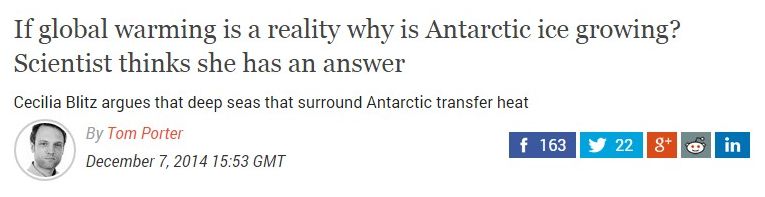
It is one of the greatest puzzles in the science of climate change, and has been used by skeptics to cast doubt on global warming: Why, when the world is getting hotter, is the Antarctic getting colder?

Now, a scientist thinks she may have uncovered the answer.


Cecilia Bitz, an atmospheric scientist from the University of Washington in Seattle, believes that oceanic currents are taking heat away from Antarctica and carrying it north, reports the Sunday Times.


Yesterday, experts said that hot ocean currents around Antarctica are melting the glaciers, and today they say that ocean currents are making the water cold around Antarctica.


Another study has been published, concluding that warmer ocean waters are melting Antarctic glaciers and contributing to sea level rise. The West Antarctic Ice Sheet has enough land ice to raise sea level by 16 feet alone. Meanwhile, 2014 is making the record books as the hottest year in recorded meteorological history.


Scientists predict 16 FEET of SEA LEVEL RISE as a literal Mt. Everest melts into Antarctic seas every two years - Green - News - Catholic Online


In summary, global warming makes the water around Antarctica both hot and cold, and causes both record ice and record melt.

An 'entertaining' lesson on how cops can 'win the media' after they kill

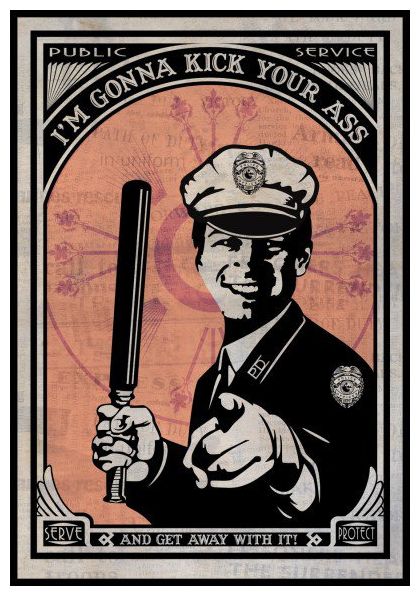
Police Brutality

© Global Research


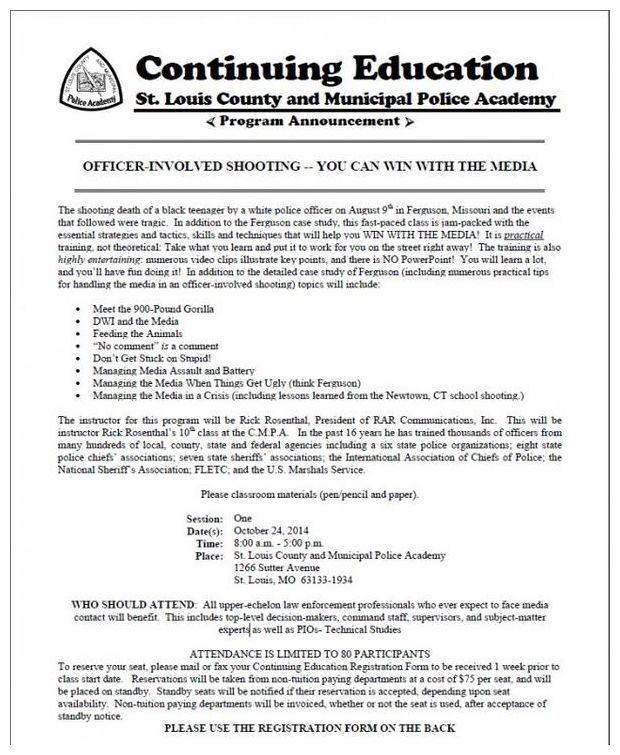
The St. Louis County and Municipal Police Academy held a special class on October 24 for "upper-echelon law enforcement professionals." The subject:


OFFICER-INVOLVED SHOOTING - YOU CAN WIN WITH THE MEDIA


The class, taught by PR agent Rick Rosenthal, focused on such topics as "Managing the Media When Things Get Ugly (Think Ferguson)." A flyer promoting the class promised, "In addition to the Ferguson case study, this fast-paced class is jam-packed with the essential strategies and tactics, skills and techniques that will help you WIN WITH THE MEDIA!"

Sound boring? Not at all! "The training is also ," the flyer emphasized. "You will learn a lot, and you'll have fun doing it!"


That sound like fun - learning how to best manipulate the media after your colleagues have killed a human being.


Police Flyer
© FAIR Org

The flyer from the St. Louis Police Academy promising to teach officers how to "WIN WITH THE MEDIA!" after cops have killed someone. Larger Version


In case you weren't able to join in the festivities, Rosenthal shared some of his insights with the cop-oriented website PoliceOne.com (8/2/12), in an interview headlined "Feeding the Animals: 10 Tips for Winning With the Media After an OIS." (OIS= Officer-Involved Shooting - imagine if you had to say that whole phrase every single time!)

The headline is a reference to Rosenthal's advice to "feed the animals early and often" - by which he means "talking to the media." And the article explains why you do that:


The more information they are fed after an OIS, "the less likely they'll go foraging on their own, finding far less knowledgeable and far less credible 'sources' for 'news' that is often based on innuendo, hearsay, speculation, vengeance and biased personal opinion."


"Foraging on their own" means journalists talking to sources (or "sources") who aren't the police. If you follow Rosenthal's tips for handling the "animals," apparently you can avoid that disastrous phenomenon altogether.

Former St. Louis cop: 'I won't say all, but many of my peers were deeply racist'

police

© Unknown


As a kid, I got used to being stopped by the police. I grew up in an inner-ring suburb of St. Louis. It was the kind of place where officers routinely roughed up my friends and family for no good reason.

I hated the way cops treated me.


But I knew police weren't all bad. One of my father's closest friends was a cop. He became a mentor to me and encouraged me to join the force. He told me that I could use the police's power and resources to help my community.


So in 1994, I joined the St. Louis Police Department. I quickly realized how naive I'd been. I was floored by the dysfunctional culture I encountered.


I won't say all, but many of my peers were deeply racist.


One example: A couple of officers ran a Web site called St. Louis Coptalk, where officers could post about their experience and opinions. At some point during my career, it became so full of racist rants that the site administrator temporarily shut it down. Cops routinely called anyone of color a "thug," whether they were the victim or just a bystander.


This attitude corrodes the way policing is done.


As a cop, it shouldn't surprise you that people will curse at you, or be disappointed by your arrival. That's part of the job. But too many times, officers saw young black and brown men as targets. They would respond with force to even minor offenses. And because cops are rarely held accountable for their actions, they didn't think too hard about the consequences.


Once, I accompanied an officer on a call. At one home, a teenage boy answered the door. That officer accused him of harboring a robbery suspect, and demanded that he let her inside. When he refused, the officer yanked him onto the porch by his throat and began punching him.


Another officer met us and told the boy to stand. He replied that he couldn't. So the officer slammed him against the house and cuffed him. When the boy again said he couldn't walk, the officer grabbed him by his ankles and dragged him to the car. It turned out the boy had been on crutches when he answered the door, and couldn't walk.


Back at the department, I complained to the sergeant. I wanted to report the misconduct. But my manager squashed the whole thing and told me to get back to work.


I, too, have faced mortal danger. I've been shot at and attacked. But I know it's almost always possible to defuse a situation.


Once, a sergeant and I got a call about someone wielding a weapon in an apartment. When we showed up, we found someone sitting on the bed with a very large butcher knife. Rather than storming him and screaming "put the knife down" like my colleagues would have done, we kept our distance. We talked to him, tried to calm him down.


It became clear to us that he was dealing with mental illness. So eventually, we convinced him to come to the hospital with us.


I'm certain many other officers in the department would have escalated the situation fast. They would have screamed at him, gotten close to him, threatened him. And then, any movement from him, even an effort to drop the knife, would have been treated as an excuse to shoot until their clips were empty.


* * *


I liked my job, and I was good at it.


But more and more, I felt like I couldn't do the work I set out to do. I was participating in a profoundly corrupt criminal justice system. I could not, in good conscience, participate in a system that was so intentionally unfair and racist. So after five years on the job, I quit.


Since I left, I've thought a lot about how to change the system. I've worked on police abuse, racial justice and criminal justice reform at the Missouri ACLU and other organizations.


Unfortunately, I don't think better training alone will reduce police brutality. My fellow officers and I took plenty of classes on racial sensitivity and on limiting the use of force.


The problem is that cops aren't held accountable for their actions, and they know it. These officers violate rights with impunity. They know there's a different criminal justice system for civilians and police.


Even when officers get caught, they know they'll be investigated by their friends, and put on paid leave. My colleagues would laughingly refer to this as a free vacation. It isn't a punishment. And excessive force is almost always deemed acceptable in our courts and among our grand juries. Prosecutors are tight with law enforcement, and share the same values and ideas.


We could start to change that by mandating that a special prosecutor be appointed to try excessive force cases. And we need more independent oversight, with teeth. I have little confidence in internal investigations.


The number of people in uniform who will knowingly and maliciously violate your human rights is huge. At the Ferguson protests, people are chanting, "The whole damn system is guilty as hell." I agree, and we have a lot of work to do.


Ancient cave art reveals origins of symbolic thought

cave popcorn

© Christopher Brand


Three years ago, on an expedition to Sulawesi, one of the larger islands in the Indonesia archipelago, the archaeologist Adam Brumm visited a cave decorated with ancient art: mulberry-colored hand stencils and paintings of corpulent pig-deer and midget buffalo, complete with hairlike brush strokes. Squeezing past a giant block of limestone at the cave's entrance, Brumm made his way toward a narrow nook and crawled along it. There, on a section of ceiling less than a foot above his head, he saw ghostly silhouettes of human hands speckled with warty growths of calcite known as "cave popcorn."

A year later, Brumm returned with his colleague Maxime Aubert and a diamond-bladed saw. Aubert specializes in using calcite - which contains trace amounts of steadily decaying radioactive uranium - to determine precise dates for ancient rock art. Researchers had long assumed that Sulawesi's cave paintings were less than 10,000 years old; anything older, the thinking went, would have eroded in the island's humid climate. But Brumm and Aubert's analysis, published in October, revealed that one hand stencil is at least 39,900 years old - the oldest hand stencil on record. A nearby painting of a female pig-deer was estimated to be 35,400 years old, making it one of the most ancient examples of figurative art.


These findings are the latest in a series of discoveries urging researchers to rethink the origins of human creativity and symbolic thought. Homo sapiens began to emigrate from Africa between 60,000 and 125,000 years ago, but did not reach Europe until about 40,000 years ago. It was only there, concluded 20th-century archaeologists, that humans began to think symbolically, to make simple figurines and geometric designs and, eventually, paintings. How else to explain the abundance of Paleolithic art in Europe and the comparatively sparse Stone Age galleries of Africa and Asia?


"There has always been the belief that a light switched on in Europe, and there was this efflorescence of creativity," says Brumm, a research fellow at Griffith University. "That's not the case. On the other side of the world, the same thing was going on at the same time." Indeed, it might have happened earlier. Brumm and a growing number of archaeologists are ready to abandon longstanding Eurocentric views regarding the origin of human imagination. Like so much that makes us human, symbolism appears to have emerged early on in Africa and spread from there.


Different researchers have defined "symbol" in different ways, but at the most fundamental level a symbol is something that represents something else: a two-dimensional outline of a three-dimensional beast; a band of gold indicating matrimony. The use of symbols is an impressive mental feat. It requires the mind to escape the bonds of literality, to see in something more than is actually there.


Christopher Henshilwood of the University of Bergen has discovered some particularly compelling evidence of pre-European symbolism in South Africa's Blombos cave. When he first started excavating Blombos in 1991, few researchers believed that symbolism might have emerged before 50,000 years ago. But Henshilwood's subsequent discoveries - and those of other archaeologists working in Africa and the Levant - began to change minds. At Blombos, he and his team unearthed a 100,000-year-old animal-bone paintbrush and palettes: abalone shells in which prehistoric humans mixed pulverized red ocher with bone marrow, charcoal and water to form a colorful paste. The cave also contained an ocher slab with 75,000-year-old geometric engravings and 41 sea-snail shells drilled through with holes so they could be strung as beads.


"There is now a great deal of support for the notion that symbolic creativity was part of our cognitive repertoire as we began dispersing from Africa," says Paul Pettitt, an expert in Paleolithic art at Durham University. Henshilwood adds that what archaeologists have found so far may be a fraction of what existed; a lot of ancient art in Africa was most likely painted on exposed rocks and eroded by the elements over millenniums.


Humans are not the only animals that understand symbolism: Bonobos can form simple sentences using pictograms on a tablet computer, and researchers have trained capuchin monkeys to purchase grapes, apples and Jell-O with aluminum discs. As far as we know, however, only humans make symbols from scratch.


Before early hominins (our nearest primate ancestors) created symbols of their own, they recognized them in nature - in particular, uncanny semblances of the living in the inanimate. Three million years ago in South Africa, an ancient hominin stumbled onto a red jasperite pebble weathered in such a way as to resemble a face. He or she was mesmerized enough to make the stone a keepsake, carrying it back to a home base several miles away, where it was found by modern researchers. Paleolithic hominins also had a penchant for collecting fossilized coral, snails and shellfish.


This primal fascination with naturally occurring symbols coincided with a nascent appreciation for the aesthetics of tools. I recently visited a forthcoming exhibit at the Cooper Hewitt, Smithsonian Design Museum in New York, where a few prehistoric tools are on display. A 300,000-year-old hand ax was particularly gorgeous: a teardrop of russet flint marbled yellow and gray, tapered neatly to a point. I could see the many marks where one of our distant ancestors had struck the stone again and again to achieve its striking symmetry.


To make such hand axes - the oldest of which date to 1.76 million years ago - early hominins had to imagine a finished tool in a lump of rock and guide their hands to realize it. Chimpanzees use this same mental process when they strip twigs of leaves to make ant-fishing rods, but they never continue the process beyond the minimum required for a tool to work. But early humans became dissatisfied with the merely pragmatic. They spent a great deal of time and effort making their tools beautiful, sometimes struggling with unmalleable but attractive materials.


A few ancient hand axes are so handsome, large and heavy - to the point of being unwieldy - that some researchers have argued they were not intended for practical use, but were instead meant to attract mates by symbolizing skills or status in a group. Once early humans realized that their handicrafts could be both utilitarian and symbolic, both functional and beautiful, it would not have taken a great leap to start experimenting: to try recreating with stone and paint the icons they observed in weathered pebbles, fossils and their own handprints.


Even as they evolved, symbols never stopped being tools. The suggestion of a human hand on a cave wall, a nation's flag, even a Rothko - each is a powerful mental heuristic designed to conjure a particular emotion, a memory, an idea. Rather than directly changing the world around us, symbols change the way we perceive it. They extend not our bodies, but our minds.


Magnitude-6.6 tremor is second large quake to rock Panama in 3 Days

Panama Quake_081214

© USGS


A magnitude-6.6 earthquake struck off the coast of Panama on Monday, the second strong quake to rock the country in three days. The tremor was centered 20 kilometers (12 miles) south-southeast of the Punta de Burica peninsula, near the border with Costa Rica, and hit just before 4:00 a.m. local time, according to the U.S. Geological Survey.

Despite the earthquake's magnitude and widespread shaking, the director of Panama's National Civil Defense Service, José Donderis, indicated via Twitter that there were no reports of damage. The epicenter of the quake, which occurred at a depth of 20 kilometers, was about 58 kilometers south-southwest of the city of David, Panama's third-largest city with a population of about 145,000 people. Any aftershocks are expected to be less intense, however, they could be strong enough to cause damage to infrastructure possibly weakened by the main earthquake.


Another earthquake struck off the coast of Panama on Saturday, near the epicenter of Monday's quake. Both earthquakes occurred along the Panama Fracture Zone, the largest and most seismically active tectonic boundaries in the region. Earthquakes along the Panama Fracture Zone are typically of low to intermediate magnitude (less than magnitude 7.2) and occur at shallow depths, according to the USGS. The largest earthquake in the area since 1900 took place in July 1962 and measured magnitude 7.2.


Panama celebrated the 100-year anniversary of the opening of the Panama Canal in August, an engineering marvel that transformed the nature of trade in the Americas. The multibillion-dollar, 77-kilometer-long (48-mile) canal connects the Pacific and Atlantic Oceans and was the largest engineering project undertaken by the United States when it was completed in 1914. The project revolutionized shipping from the East Coast of the U.S. to the West Coast of the Americas, Europe and Asia.


Dear Mr. Putin, We were only playing hard to get

Jean-Claude Juncker

© Unknown

Jean-Claude Juncker


How do you get €300 billion in (probably largely useless) "infrastructure investment" in Europe? Banning a $40 billion project from going forward is probably not going to help, not to mention that this one would actually have been useful. After Gazprom announced last week that it has had enough and is ditching the South Stream pipeline project (see "South Stream Dies" for details) after having invested $5 billion and run into countless politically motivated obstacles, EU commissariat president Juncker engaged in a back-tracking exercise, garnished with some nonsense about "Russia holding Bulgaria to ransom". Very likely he got an earful from Bulgarian prime minister Boiko Borisov about the EU's sabotage of the project:

"European Commission President Jean-Claude Juncker has insisted the $40 billion South Stream natural gas pipeline can still go ahead and accused Russia of holding EU-member Bulgaria to ransom when it said it had abandoned the project.


Speaking after talks with Bulgarian Prime Minister Boiko Borisov, whose country South Stream would traverse making it a major beneficiary, Juncker rebutted Russia's statement that EU competition rules had killed it. He told reporters issues relating to the pipeline were not insurmountable and he was working with Bulgaria to address them.


Russia said on Monday it had abandoned the pipeline, which would have bypassed Ukraine, Gazprom's traditional transit route for Russian gas, citing EU competition requirements for a pipeline's ownership to be divorced from its cargo. It said it was working on an alternative route via Turkey.


Juncker accused Moscow of blackmailing Bulgaria, which retains strong political and economic ties with Moscow and is almost entirely dependent on Russia for its gas. "I am not accepting the simple easy idea that Bulgaria can be blackmailed as far as these energy relations are concerned," Juncker said.


"We'll take ... all the necessary steps to make sure that our relations with Russia will be improved, but it doesn't depend only on the willingness of the EU, of the European Commission. To dance a tango ... you need two dancers."


Borisov also said South Stream could be built and agreed it had to comply with EU rules, including legislation known as the third energy package, which limits how much of a pipeline a company can own if it also controls its contents. Further efforts to bring the project in line will be made on Tuesday, when EU energy ministers meet for regular talks. "I hope that all these technical details will be solved at this meeting including the third energy package," Borisov said. He added he had not received any official notice from Russia that South Stream was not going ahead.


EU sources, speaking on condition of anonymity, said Russia's calculation could have been that its announcement of South Stream's demise would place the Commission under pressure from some member states to soften its regulatory stance. At the same time, Russia has a struggle [sic, ed.] to find the cash for South Stream, given a falling oil price and economic sanctions."


(emphasis added)

A few remarks to the above: yes, the Bulgarians are understandably up in arms, but had it been up to them, the construction activities would never have been interrupted in the first place. As things stand, the previous Bulgarian government was badgered by the EU and visited by John McCain, whose primary mission was apparently to stop the pipeline from being built. The government announced that all construction on the pipeline would be stopped .


© Photo by BGNES

Boiko Borisovich, here pictured shortly before jumping down JC Juncker’s throat. We would recommend not angering him too much: he’s a former bodyguard with a black belt in karate. His nickname is “Batman” (no kidding!).


Could it be that Gazprom announced the cancellation merely to put pressure on the EU Commission? It is certainly possible. Note, we doubt that lower oil prices are a "cause" of anything here. This is not an oil pipeline, it is a natural gas pipeline - which is a different, if related market. While bulk sales prices are not entirely independent of market prices, there are long term delivery contracts designed to give pricing and planning security to both consumers and producers.

However, Gazprom does have a financing problem - mainly due to EU sanctions. It can no longer refinance its short term foreign currency denominated debt in Western markets. Obviously this means the company will have to reassess some of its investment plans. And it should be clear that an investment that has so far run into nothing but obstacles from the EU bureaucracy is likely among those to be culled. In fact, even if the "competition" problems are sorted out (which we assume would be quite easy to do - key word: "North Stream"), Gazprom may decide not to go forward, because the financing issue could be seen as too risky.


Juncker says the EU will do whatever it can to improve relations with Russia and it is certainly true that if there are disagreements it always "takes two to tango". However, let us stop to think for a moment what this means in unambiguous, clear language. From the perspective of the EU (and the US) leadership, it means that Russia's government must accede 100% to every demand they make. We already pointed out that this is an essentially fascist foreign policy. Nothing but complete surrender is acceptable. We don't think it would be impossible to come to an agreement regarding the Ukraine crisis that everybody could in theory live with (the über-hawks in both the US and Russia excepted - basically the neo-cons in the US and assorted nationalists in Russia We do have a tad more understanding for the paranoia of former Eastern Bloc countries). By now it should be rather glaringly obvious though that economic sanctions and demonizing the Russian leadership at every opportunity won't do the trick.


As an aside to all this, it certainly couldn't possibly get more embarrassing. Only last Monday, the European State propaganda orga...sorry, the European mainstream press, printed triumphalist headlines like this one, which translated means "EU Victory Over Moscow's Pipeline Policy" - below the headline we read "bureaucrats have brought Putin to his knees, not diplomats". An appropriate comment on this would be a variation of a famous saying by King Pyrrhus of Epirus:


Conclusion:


Although every bad thing that is not the fault of climate change is allegedly the fault of Putin, it seems the EU commissariat "didn't really mean it" and wants to see South Stream built after all. Here is an idea: lock them all in a room with Borisov for an hour and let him use his special powers of persuasion on them; that should hasten the process.


© Photo via glasove.com / Author unknown

Boiko “Batman” Borisov in action


© Silvia Gurmeva

That looks like it may have hurt.


Six sperm whales found dead in rare mass beaching in South Australia


© aptn


A pod of six sperm whales washed up dead Monday in a rare mass stranding on the South Australia coast, with animal welfare officials struggling over the logistics of handling the huge carcasses.

The whales, which can weigh up to 50 tonnes, were found at low tide by residents on Parara beach, about 93 miles northwest of Adelaide.


"We're not sure why they beached," a Department of Environment official told AFP.


"A theory is that one was ill and moved to shallow waters and then called out to fellow pod members who followed it in."


A local fisherman suggested they could have been chasing a school of salmon.


[embedded content]


Animal welfare manager Deborah Kelly said it was rare to see whales beach in the area.

"I haven't seen a marine event like this in South Australia since the mass stranding of 58 dolphins at Nepean Bay in the 1990s," she told the


The department official said police and the council were considering their options on how to handle the carcasses, which were now in shallow waters and could attract sharks.


"It's a very big logistical task," the official said.


Sperm whales is the largest of the toothed whale species and can grow up 52 feet. It has the largest brain of any known animal currently in existence.


© aptn